


In vacuum systems, the KF (Klein Flange) clamp is a small but critical component – it ensures leak tight seals between flanges. However, not all KF clamps are identical. If you have compared products from different suppliers, you may have noticed subtle (or even obvious) design variations.
Today, the two dominant standards are the European (EU) and the American (US) standards. Although their core function is the same, their appearance clearly differs. This article clarifies these differences so that you can confidently select the right clamp whether you are in Boston, Berlin, or anywhere else.
1. Visual Differences at a Glance
The most noticeable differences are found in two areas: the hinge design and the clamp tail structure.
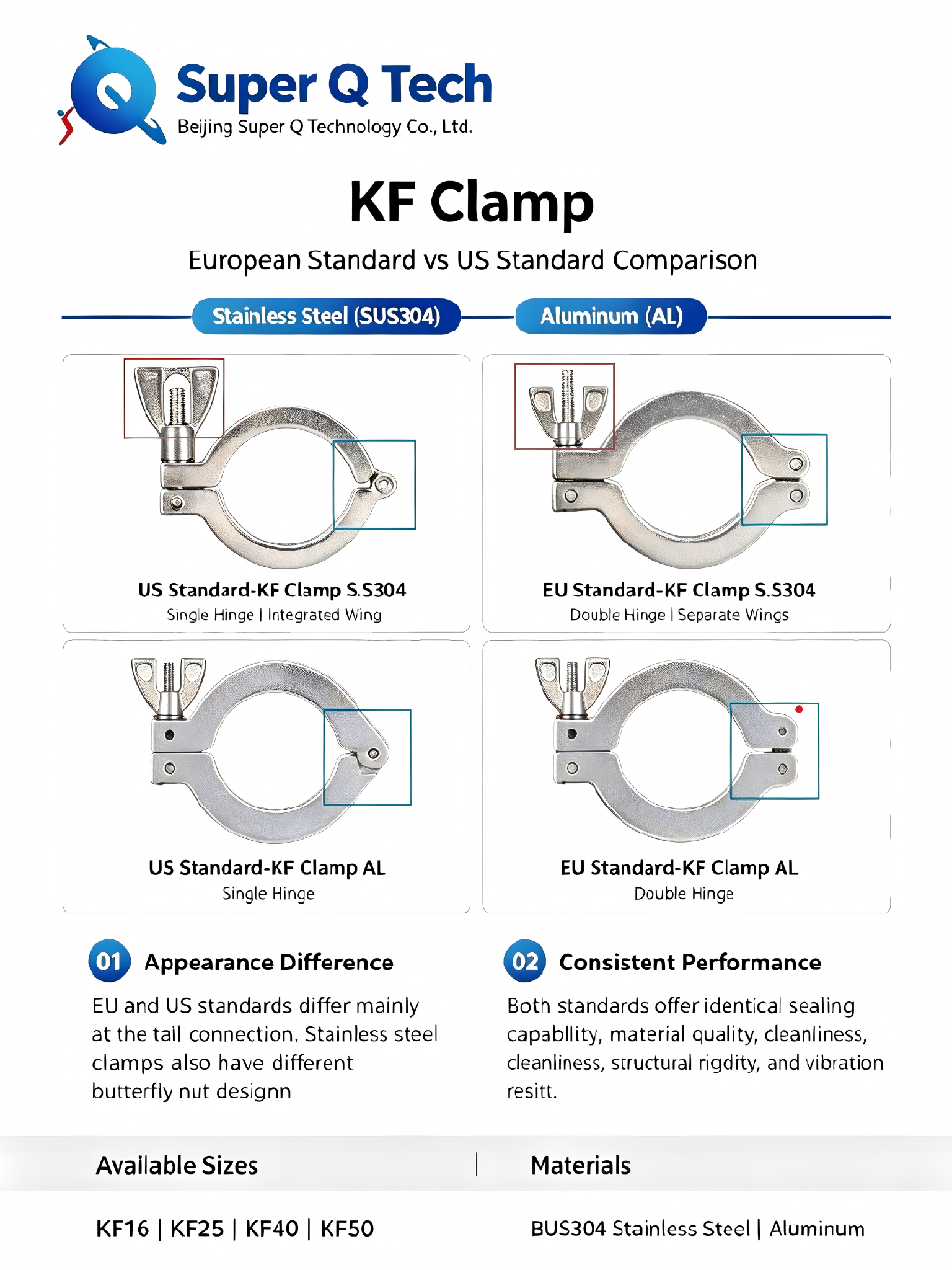
- · Stainless steel (SUS304) clamps
- o US: The wing nut and hinge pin are forged as one piece.
- o EU: The wings are separate components attached via screw pins, giving a more modular look.
- · Aluminium clamps
The two standards also differ in the number of hinges: US uses a single hinge, EU uses a double hinge. The wing nut design is relatively simpler, but the hinge count remains a key differentiator.
In a nutshell:
Look at the hinge – single or double? Then check the wing nut – integrated or split? You can tell which standard it is at a glance.
2. What About Performance?
What engineers and procurement professionals find most reassuring is that both standards are fully equivalent in performance.
These two designs are not about one being better than the other; they simply reflect long standing regional preferences. In practical applications, they provide:
- · Same sealing capability – both work with the same O rings and centring rings, achieving identical vacuum sealing performance when properly installed.
- · Same material quality – SUS304 stainless steel or aluminium, with comparable corrosion resistance and strength.
- · Same cleanliness – both are manufactured to high purity standards.
- · Same structural rigidity – clamping force and mechanical stiffness are comparable, ensuring stable connections under thermal cycling and vibration.
- · Same vibration resistance – both designs firmly secure flanges in high vibration environments (e.g., turbo molecular pumps or roughing lines).
In other words, as long as the flange sizes match, you can mix US and EU clamps in the same system – there is no functional impact. The choice depends solely on sourcing channels, cost, or personal preference.
3. Available Sizes and Materials
Both standards cover the most common KF flange sizes: KF16, KF25, KF40, KF50, and offer two material options:
- · SUS304 stainless steel – for high temperature, corrosive media, or long term durability.
- · Aluminium – for weight sensitive applications (e.g., portable systems) or cost effective solutions.
4. What Does This Mean for Your Procurement?
When you source KF clamps from global suppliers, you may receive either standard depending on the manufacturer’s origin. Understanding these differences helps you:
- · Avoid confusion during incoming inspection – you won’t mistake a perfectly good EU product as defective just because it looks “different” from a US one.
- · Make informed choices if you prefer one style over the other (e.g., double hinges may be easier for one handed operation, while single hinges are more compact).
- · Communicate clearly with suppliers – explicitly specify “US standard” or “EU standard” to ensure you receive the exact version you expect.
5. Conclusion
Different looks, identical performance.
Whether you choose the US style single hinge, integrated wing design or the EU style double hinge, split wing design, you get a reliable, high quality clamp that meets the same rigorous vacuum requirements. Next time you encounter a KF clamp with an unfamiliar hinge, you’ll know – it’s not a defect, just a distant cousin.
Need KF clamps in SUS304 or aluminium?
Feel free to contact us for samples or to discuss your application needs – no matter which side of the pond you are on, we’ll help you select the right product.
Post time: Aug-03-2026